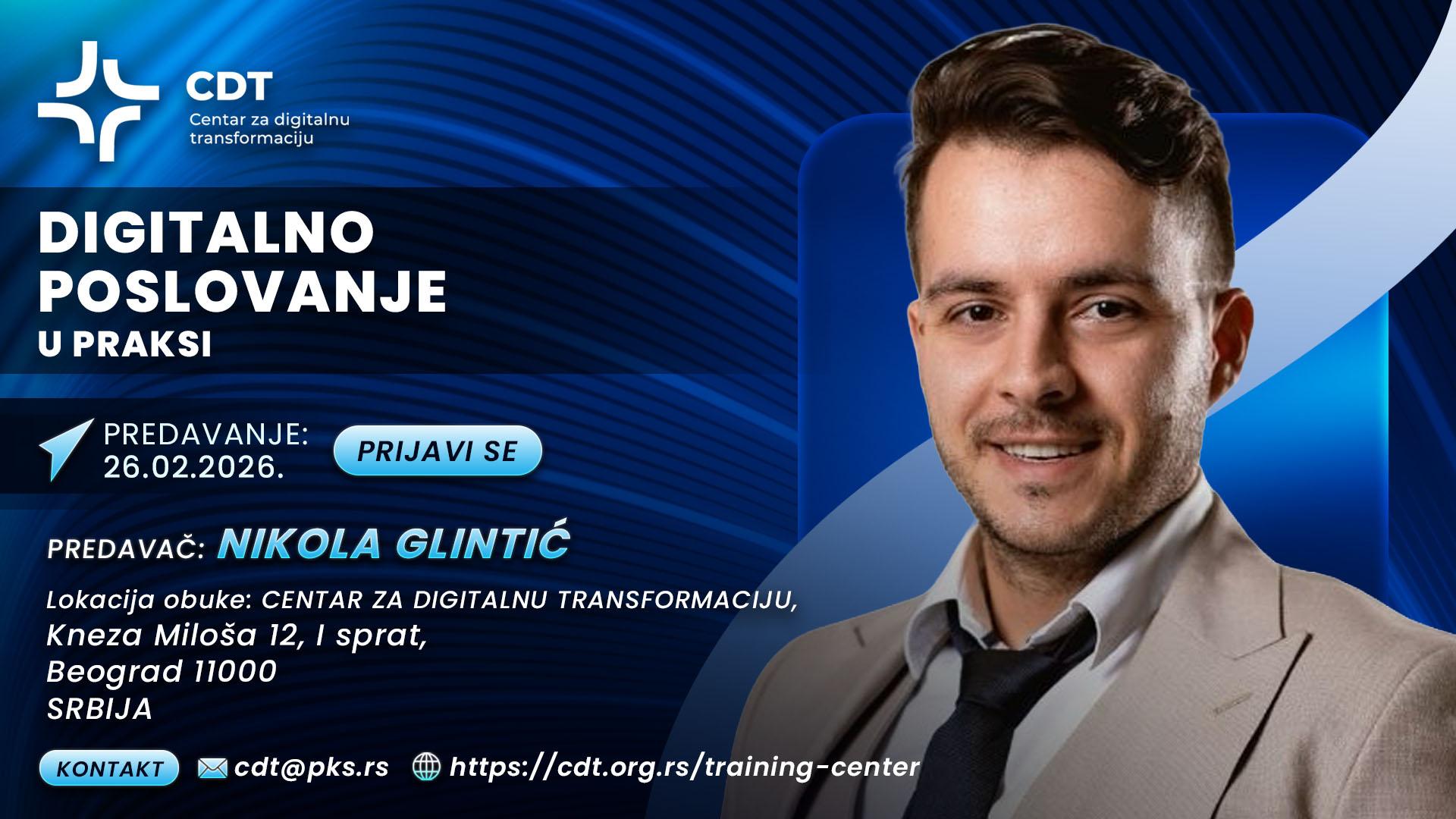
Digital Business in Practice
ABOUT THE LECTURER
Nikola Glintić is a graduate and master economist, a chartered accountant of the Association of Accountants and Auditors of Serbia and a licensed tax advisor licensed by the Association of Tax Advisors of Serbia, with a clear focus on the digital transformation of finance, bookkeeping and tax management. Nikola is an entrepreneur himself, the founder of SP NIKOLA FINCON Novi Sad.
Nikola has positioned himself as a modern, agile and technology-oriented financial expert, specializing in working with entrepreneurs, startups and the IT community. In his practice, he has helped a large number of entrepreneurs to start a business, choose the optimal tax and organizational model, and set up digitally efficient financial processes from the very beginning.
His work stands out for its strong reliance on digital tools, automation and modern cloud solutions, enabling clients to have less administration, better business control and greater regulatory compliance. He brings special value in cooperation with IT companies and technology teams, where he understands the speed, agility and specific needs of digital businesses.
Nikola does not see bookkeeping and taxes as an expense, but as a strategic tool for growth, scaling and long-term business stability.
For those who want to get to know Nikola before the lecture, and at the same time learn useful information about taxes and bookkeeping, on Nikola's social networks you can find short videos with examples and solutions to the most common challenges and mistakes in practice:
LinkedIn: linkedin.com/in/nikola-glintic-fincon
Instagram: instagram.com/fincon_novi_sad
In addition, Nikola is the author of several e-books "How not to ruin your business" that are available to students.
WORKSHOP: DIGITAL BUSINESS IN PRACTICE
The workshop will be held on February 26, 2026 in the premises of the Center for Digital Transformation at Kneza Miloša 11, Belgrade, in the hall of the Training Center on the mezzanine, from 10:00 to 15:00. Coffee will be provided during the break.
Registration for the workshop is done via the following link: APPLICATION LINK
The price of the workshop is 15,000 dinars + VAT. After filling out the application form, all registered candidates will receive a proforma invoice via e-mail, on the basis of which the payment must be made no later than three days before the workshop.
The effective duration of the workshop is 4 hours. All participants will receive a certificate of attendance issued by the Center for Digital Transformation and confirmation of 4 Professional Education Hours (PEH).
For additional questions, contact the Center for Digital Transformation at cdt@pks.rs with the subject "Workshop: Digital Business in Practice".
LECTURE SUMMARY
The lecture provides a practical and strategic overview of key business models in Serbia – freelancers, entrepreneurs and companies (LLCs) – with a special focus on digital obligations, tax implications and new regulatory requirements coming into force by and in 2026.
Through concrete examples and live demonstrations of platforms and tools, the lecture explains the digital ecosystem of the state (eTaxes, eGovernment, CROSO, eInvoices, eFiscalization, eDelivery Notes, eSick Leave, eBills of Exchange) and shows what is actually visible in the systems, where mistakes occur and what the digital footprint of a business looks like.
A special section is dedicated to the impact of artificial intelligence on accounting and financial management, with real examples of AI tools in everyday use, clearly distinguishing what can be automated and where the human factor remains irreplaceable.
OBJECTIVES OF THE WORKSHOP
- Understand differences between business models and make informed decisions
- Gain a clear picture of digital and tax obligations for each model
- Identify the most common mistakes and risks in digital business
- Prepare for new digital obligations and controls by 2026
- Understand the real role of digital tools, data and AI in accounting and finance
BENEFITS FOR PARTICIPANTS
- Less uncertainty and more business control
- Clear understanding of what the state sees and how data is connected
- Ability to choose or change a business model at the right time
- Practical knowledge of digital systems already in use or upcoming
- Realistic insight into how AI saves time and increases accuracy