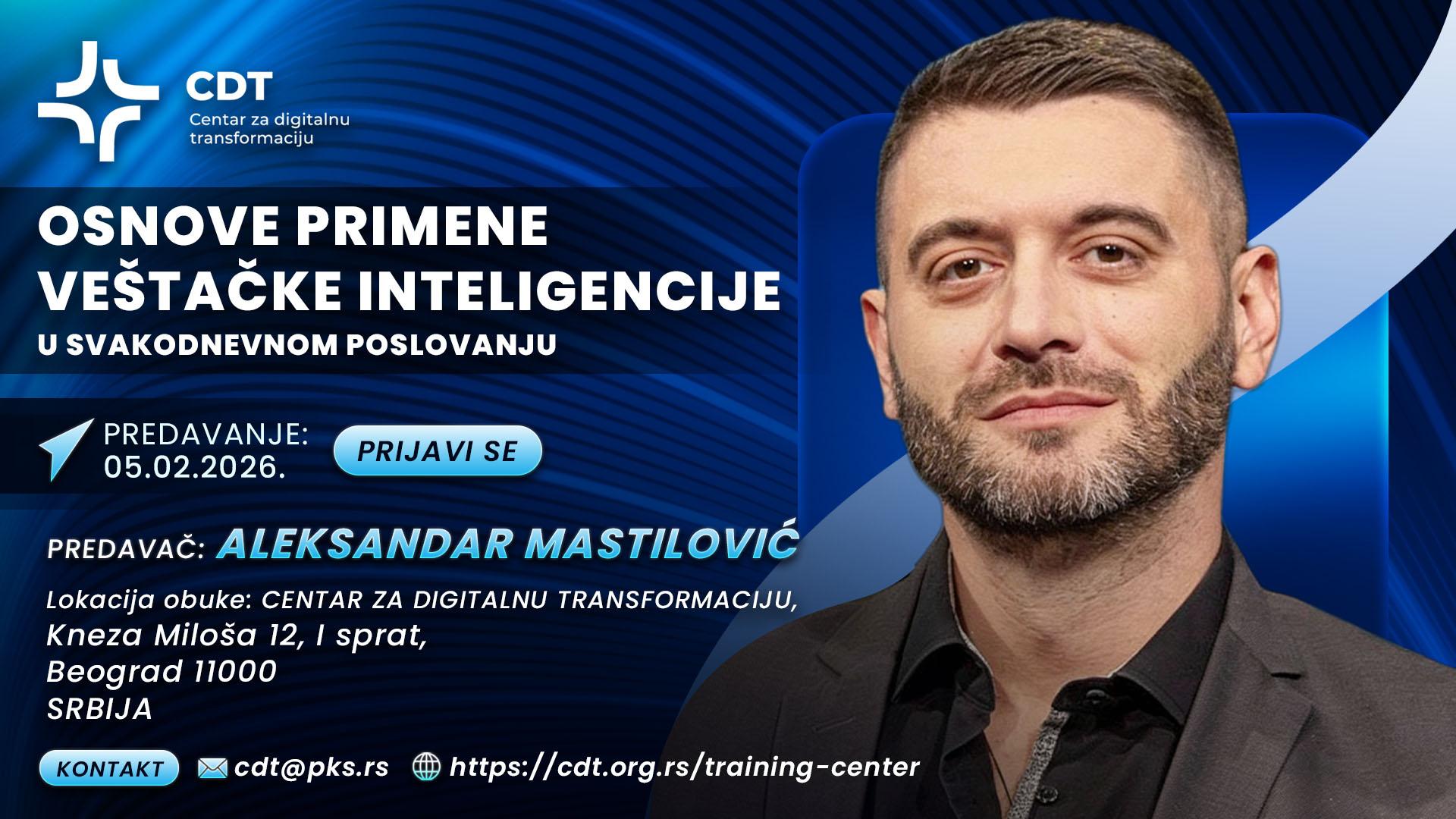
THE BASICS OF ARTIFICIAL INTELLIGENCE IN EVERYDAY BUSINESS
ABOUT THE LECTURER
Aleksandar Mastilović is recognized as one of the leading authorities in the field of engineering and technology at the global level. His rich interdisciplinary experience includes the technical and technological implementation of 5G technology and the establishment of a regulatory framework for telecommunications technologies and markets with a focus on the development of competition and the prevention of monopolization, as well as the implementation of telecommunications market analyses, the development of smart cities, as well as the promotion of digital transformation in public administration and small and medium-sized enterprises (SMEs). Its primary mission is to transform academic achievements and scientific innovations into entrepreneurial endeavors that connect business, academia, and the public sector.
Since 2021, he has been working closely with the Serbian Chamber of Commerce and the Center for Digital Transformation of Serbia, where he contributes to the transfer of state-of-the-art technological solutions to business and industry, with a special focus on successful applications of artificial intelligence in SMEs in Serbia and the Western Balkans region. In addition, Aleksandar Mastilović is an external advisor to a number of venture capital funds, investment funds and organizations, including the World Business Angels Forum (WBAF).
Since 2021, he has been a member of the WBAF Board for Science, Technology and Innovation at the global level with headquarters in Istanbul (Turkey), and in the professional sphere a member of the IEEE Board of Directors for Publications of the Institute of Electrical and Electronics Engineers in New York (USA), the world's largest professional organization with a decisive impact on technological development and standardization of innovations
In 2023, he founded the consulting firm AM Consulting - Aleksandar Mastilović SP based in Novi Sad, Serbia, and is currently in the process of opening an office in East Sarajevo, Bosnia and Herzegovina.
From 2024, he was appointed as the national coordinator of UNOPS for Bosnia and Herzegovina.
Currently, Alexander provides consulting services to a number of reputable international organizations, including global financial institutions such as the European Bank for Reconstruction and Development (EBRD), the European Investment Bank (EIB) and the World Bank (WB), as well as United Nations agencies, including the United Nations Office for Project Services (UNOPS), the United Nations Development Programme (UNDP) and the International Telecommunication Union (ITU). It also cooperates with other international organizations such as the German Organization for International Economic Cooperation (GIZ) and the United States Agency for International Development (USAID).
As an EU Marie Curie Fellow, his professional path has been marked by significant achievements, including the recognition of the IEEE Communications Society Global Top 30 Award for doctoral students in the field of telecommunications, which he received in 2015. He has also been a visiting researcher at renowned universities, including Rutgers University, the University of Sydney and La Trobe University, where he represented the European research community on the global stage.
In 2022, London-based analytics firm Onalytica ranked him among the top 10 most influential global influencers in the field of smart cities. As an author, Alexander has participated in the preparation of nine scientific papers presented at international conferences and is the co-author of a book on cybersecurity in industrial Internet of Things (IoT) systems, published by IGI Global (USA). He also held a TEDx lecture dedicated to smart cities, and is one of the co-founders of the largest event in the field of smart cities in the Western Balkans region – Smart Cities Festival.
His contribution to public policy-making includes facilitating the deployment of the 4G network in Bosnia and Herzegovina, as well as the establishment of a "roam like at home" regime for the Western Balkans region, further cementing his position as a visionary leader in the field of telecommunications and digital transformation. In recent years, he has recognized as a personal mission the need to interdisciplinary technologies and the joint work of the public sector, engineers, lawyers and economists to create sustainability and minimize the risk of uncontrolled introduction of technological solutions in the public sector and economy, especially artificial intelligence and blockchain, and the development of an intelligent regulatory framework that minimizes risks but at the same time does not slow down innovation and entrepreneurship.
LinkedIn: linkedin.com/in/aleksandarmastilovic
WORKSHOP: THE BASICS OF ARTIFICIAL INTELLIGENCE IN EVERYDAY BUSINESS
The workshop will be held on February 5, 2026 in the premises of the Center for Digital Transformation, Kneza Miloša 11, Belgrade, in the hall of the Training Center on the mezzanine, in the period from 10:00 to 16:00. During the break, coffee will be provided.
Registration for the workshop is done via the following link: APPLICATION LINK
The price of the workshop is 15,000 dinars + VAT. After filling out the application form, all registered candidates will receive a proforma invoice via e-mail, on the basis of which it is necessary to make the payment no later than three days before the start of the workshop.
The workshop is intended for both individuals and legal entities, i.e. you can register through your company or individually. A discount will be provided for legal entities that send 3 or more participants to the workshop, and more information can be obtained by e-mail: cdt@pks.rs.
The effective duration of the workshop is 5 hours and all participants will be issued a certificate of attendance by the Center for Digital Transformation and a certificate of 5 hours of professional education (PEH points).
Especially for this workshop, the participants of this workshop will subsequently be offered the option of AI Practitioner certification with global validity issued by Austrian Standards.
For all additional questions and information, contact the Center for Digital Transformation via e-mail cdt@pks.rs with the obligatory title "Workshop: Digital Business in Practice".
LECTURE SUMMARY
Artificial intelligence is no longer a futuristic concept – it is an operational tool that is already redefining productivity, output quality and the competitive position of organizations. This lecture provides a practical guide to key AI tools applicable in everyday business, with a focus on specific use-case scenarios and hands-on demonstrations.
Generative AI assistants represent a new paradigm of work productivity. We analyze four leading platforms: ChatGPT (OpenAI) as a market leader with advanced reasoning capabilities; Claude (Anthropic) who excels in analytical tasks and longer contexts; Qwen (Alibaba) as a competitive open-source alternative; and DeepSeek, which demonstrates how China's AI ecosystem competes with global players. Each platform has distinct advantages – the choice depends on the specific business context.
AI-native presentation tools such as Gamma.app and Beautiful.ai eliminate the multi-hour design process, allowing visually professional presentations to be generated from text input in minutes. This fundamentally changes the ROI of preparing for client meetings and internal presentations.
The lecture also maps a broader ecosystem of AI tools for specific business functions: documentation automation, data analysis, visual content creation, email communication optimization, meeting transcription and summarization, and AI-assisted research and market intelligence.
The goal is not to replace human expertise, but to augment it – positioning AI as a "co-pilot" that amplifies the team's capacities. Participants will come up with a concrete action plan for integrating AI tools into their workflows, while understanding the limitations, risks, and best practices for responsible use.
OBJECTIVES OF THE WORKSHOP
- Understand the fundamental principles of generative AI and how large language models work
- Identify key AI tools by category and their optimal applications in a business context
- Recognize the limitations and risks of AI technologies (hallucinations, data privacy, ethical issues)
- Create effective prompts that produce high-quality, usable outputs
- Independently use a minimum of 5 AI tools for everyday business tasks
- Generate business content (presentations, texts, visuals) with the help of AI in a significantly shorter time
- Evaluate and verify AI-generated outputs before business use
- Adopt mindset augmentation — AI as a tool for amplification, not a replacement for human expertise
- Develop a critical approach to AI outputs and vendor claims
- Identify opportunities for AI integration in their own workflows
BENEFITS FOR PARTICIPANTS
- Time savings: 2-4 hours per week on routine tasks (drafting, research, formatting)
- Output quality: more professional documents, presentations and communication
- Competitive Advantage: Practical Skills That 70%+ Colleagues Don't Yet Have
- Career (repositioning): AI literacy becomes a baseline expectation in the labor market
WORKSHOP AGENDA
📅 Duration: 10:00 – 16:00 (6 hours with breaks)
MODULE 1: Introduction and basics of AI
⏱ 10:00 - 11:30 (30 minutes)
- Welcome, introduction, expectations of participants
- What Is Generative AI — Demystifying Without Technical Jargon
- How ChatGPT, Claude and similar tools "think"
- Prompting 101: The Anatomy of a Good Prompt
- Limitations of AI: Hallucinations, Bias, Privacy
- Overview of the tools we will use today
MODULE 2: AI Assistants — Basic Tools
⏱ 10:30 - 11:45 (75 minutes)
ChatGPT (30 min)
- Creating an account, navigating the interface
- GPT-4o capabilities: text, image, document analysis
- Demo: document summarization, brainstorming, email drafting
- Custom instructions — how to "teach" ChatGPT your context
Perplexity AI (25 min)
- Why it's different from Google search
- Pro Search, Focus modes, citing sources
- Demo: Competitive Analysis with Verified Sources
- When Perplexity, when ChatGPT — decision framework
Google Gemini (20 min)
- Access and Google Workspace integration
- Multimodal capabilities (text + image + tables)
- Demo: Excel/Sheets Table Analysis
- Benefits for users of the Google ecosystem
🎯 Mini-exercise: Same prompt in all 3 tools — comparison of results
☕ PAUSE — 11:45 - 12:00 (15 minutes)
MODULE 3: Content Creation
⏱ 12:00 - 13:00 (30 minutes)
Presentations: Gamma.app (25 min)
- From a text prompt to a finished presentation
- Editing, changing the design, adding branding elements
- Demo: creating a live pitch deck (10 slides in 3 minutes)
- Export options, collaboration, free vs. Pro Plan
Visuals: Canva AI + Microsoft Designer (20 min)
- Canva Magic Design — Automatic Design Generation
- Text-to-Image in Canva
- Microsoft Designer as a free alternative
- Demo: social media post from idea to finished visual
Text: Quillbot and AI Writing (15 min)
- Paraphrasing, grammar checking, tone change
- When to use specialized tools vs. ChatGPT
- Demo: Transforming a formal email into a friendly tone
🎯 Mini-Exercise: Create a LinkedIn Post with Visual (Canva + ChatGPT)
🍽️ LUNCH BREAK — 13:00 - 13:45 (45 minutes)
MODULE 4: AI in Business Operations
⏱ 13:45 - 14:30 (45 minutes)
Meeting transcription: tl; DV (20 min)
- How Automatic Transcription Works
- AI summarization, extraction of action items
- Integration with Zoom, Google Meet, MS Teams
- Demo: Process a recorded meeting
- Alternatives: Fireflies, Otter, AI Notes
Audio & Voice: ElevenLabs (15 min)
- Professional-quality text-to-speech
- Voice cloning — possibilities and ethics
- Use cases: video narration, e-learning, podcast
- Demo: Generate voiceover in English
Quick overview of other tools (10 min)
- Video: HeyGen (AI avatars), Runway (editing)
- SEO: VidIQ, Seona AI
- Marketing: AdCreative.ai
- QR code for a complete list of tools
MODULE 5: Practical workshop
⏱ 14:30 - 15:30 (60 minutes)
Group work on realistic scenarios (35 min)
| Group | Task | Tools |
|---|---|---|
| A | Prepare a presentation of a new product/service | ChatGPT + Gamma |
| B | Research the topic/competition and make a one-pager | Perplexity + Canva |
| C | "Summarize the meeting" and write a follow-up email | tl; dv + ChatGPT |
Presentations and feedback (25 min)
- Each group presents the result (7-8 minutes per group)
- Discussion: What Worked, What Didn't, Lessons Learned
MODULE 6: Conclusion and Next Steps
⏱ 15:30 - 16:00 (30 minutes)
- Recap: 10 key tools and when to use them
- Decision matrix: which tool for which task
- Where to start? Prioritization for the first week.
- Risks and Responsible Use (GDPR, Company Policy, Verification)
- Creating a Personal Action Plan: "My 3 Tools for Monday"
- Sharing materials: PDF toolkit, prompt library, links
- Q&A, workshop evaluation, closing